- 2430 Group Newsletters
- Posts
- Weaponized Economies
Weaponized Economies
This week in The Red Report
For those who wish a more in depth discussion of Red Report analyses, please sign up for Red Report Live, a one-hour discussion with the authors. Each session is one hour and costs $250 per attendance or $2,500 for an annual subscription to 12 sessions. To sign up, please email [email protected].
From Zhongnanhai: This week in Chinese Politics
Talent Wars
Meta’s announced acquisition of Manus, if completed, would undermine the CCP’s drive to retain top tech talent. US companies should anticipate that the CCP will prioritize the return of Chinese employees to China from abroad. The ensuing global fight for expertise will define the AI revolution.
Analysis
If artificial intelligence is a new global arms race, then it will be won by those who employ the best people. Until recently, the United States has dominated the competition to attract and retain the top scientists and engineers. Silicon Valley’s power to entice world-leading innovators in AI, quantum, and other fields has long been the envy of the CCP, whose heavy-handed intervention in Chinese firms has historically dissuaded entrepreneurial risk at the expense of political conformity.
In the past decade, however, the CCP has made it a national priority to not only promote domestic talent, but to keep those people in the PRC. Importantly, this priority is now paying off. Chinese scholars and researchers are increasingly choosing PRC universities and companies over offers from overseas, including in the United States. While many PRC citizens still choose to study and work abroad, this gradual shift homeward will be fundamental to the where, when, and how of technological innovation this century.
The CCP’s prioritization of “home grown” expertise is evident in state media reports. The “Deepseek Moment” last year, for example, frequently emphasized how the Deepseek team were PRC citizens trained at PRC universities and driving innovation from a PRC-based company. Touting the company’s “new youth potential” (年轻高潜力), combined with a top-down emphasis on the need to attract PRC citizens working overseas with “high-level talent” (高层次人才) to return back to PRC, CCP leaders are clearly demonstrating their prioritization of domestic recruiting as a function of economic–and therefore national–security.
CCP leaders will likely therefore view Meta’s recently announced acquisition of Manus with skepticism, if not hostility. Manus is a PRC-founded firm that relocated to Singapore ahead of the acquisition. Manus is a poster child for the CCP’s emphasis on homegrown expertise. The founders are PRC citizens who graduated from PRC universities and founded a highly successful AI startup in Beijing.
The company founders’ decision to close its Beijing operations and move the company to Singapore–a more palatable destination for foreign acquisition–has already irked CCP officials. In response to Manus’ announcement, state media issued multiple directives calling for a need for "party management of talent" (党管人才): a two-fold demand that the CCP step up efforts to retain talent and to deepen the party’s control of STEM talent pipelines. The CCP’s response to Manus is clear: preventing brain drain is a national priority.
For US tech companies, retention of the best people is no longer a question of out-bidding competitors. The CCP’s formalizing of Party committees’ authority over talent recruitment and individual career advancement means that US companies will be trying to outcompete a superpower. This is also a challenge for talent pipelines. STEM graduates in the PRC will likely face mandated CCP membership as a condition for graduation, a mechanism that the party can weaponize to control where graduates can work. It also means that the percentage of CCP members among PRC-educated employees entering Western technology firms will increase, thus raising counterintelligence and IP protection risks. US tech companies need to think strategically about what the incoming war over employees will mean for their survival in the coming years.
On the Hill: Developments in US China policy
What does the TikTok deal tell us about US-China competition?
TikTok is back in the headlines, but reports about the deal’s details miss the bigger threat of Chinese tech companies outcompeting the US worldwide.
Analysis
The United States and the PRC see geopolitical competition in entirely different ways. For the CCP, devoid of term limits, elections, or the possibility of popular removal, competition with the US is planned in decades. US decision makers think and act on much shorter time scales.
The recently announced TikTok deal highlights one way in which short-term thinking is undermining US security. TikTok finalized a deal to avoid a US ban by forming a new American entity, "TikTok U.S." While the executive branch hailed this as a win, the deal creates a loophole that will likely face scrutiny on the Hill. Instead of a full technical split, ByteDance will license its algorithm to the US entity for "retraining." This tests 2024 legislation that prohibits cooperation regarding content recommendation algorithms. This prohibition was based on congressional concerns that Beijing would be able to use the algorithm to collect data on US users and promote mis- and disinformation in the US.
In short, the new details of the proposed deal suggest that not much has changed since the previous round of negotiations. Given the murky details regarding the technical aspects of this deal and the bipartisan congressional support for the previous TikTok ban, it is also likely that the new deal is soon to meet with resistance.
The ongoing TikTok deal saga underscores how the United States is fighting over piecemeal parts, while the PRC continues to fund and promote not only ByteDance, TikTok’s parent company, but also new tech giants. All of Beijing’s moves occur with the goal of global market dominance in key industries. When juxtaposed, the US and the PRC’s emphasis on different timeframes help to frame why each side appears to pursue different strategies of geopolitical control. The US administration wants a short-term political win in securing TikTok from Chinese data harvesting. PRC leadership is intent on championing its tech infrastructure so that TikTok will be one product among many.
By focusing on TikTok over broader questions of digital security and long-term competition, the United States is losing sight of the longer-term geopolitical stakes that come from geopolitical and geoeconomic competition with the PRC. In the short term, US companies should take note of the details of the TikTok case: data security, algorithm provenance, and perceived ties to Chinese tech will all be red flags for US regulators or auditors. Yet in the long term, US companies face a more daunting prospect of not just TikTok, but a flood of hundreds, and eventually thousands of other Chinese apps crowding out US company’s market share worldwide. Both should be cause for concern.
Business Matters
Trade Uncertainties Return: Venezuela, Semiconductors & Rare Earths
US intervention in Venezuela has rattled Beijing and created an opening for potentially reshaping the global economy. Despite rhetoric out of both Washington and Beijing seeking a trade detente, policies and actions indicate both sides expect the current equilibrium to fall apart (and soon).
Analysis
The beginning of 2026 has already provided evidence for the earlier Red Report predictions that the global trade equilibrium of late 2025 is not destined to last. This reality is playing out across several metrics, including the destabilization of trade due to US intervention in Venezuela, increasingly aggressive protectionist measures surrounding AI and semiconductors, and concerted G7 efforts to counterbalance the Chinese rare earth monopoly.
While the US government’s taking into custody of Venezuelan President Nicolás Maduro has had far-ranging consequences, the China factor should not be overlooked. Since 2000, China has invested more than $100B in Venezuela in the form of infrastructure projects, such as railways and power plants, while Caracas paid Beijing back with 80% of all its crude oil shipments; it is estimated that Venezuela currently owes China at least $10B. China has invested heavily in Venezuela–and Maduro specifically–to create a strategic foothold in South America, and Chinese official sources have already condemned theUS intervention as illegal and unilateral. Although the US has announced it will continue to allow China to purchase Venezuelan oil, Beijing will not receive its previously preferential price. China has also invested more heavily across the continent than the US in the last two decades, which illustrates Beijing’s desire to remain in the region long-term. As the fallout from the regime change plays out, it is likely that China will seek retaliation in other sectors where it holds the advantage–and US businesses will be stuck paying the price.
Some of these consequences are already playing out in recent changes to AI and semiconductor strategies in both the US and China. In the US, chip companies are divided about how to handle the China issue. Whereas Nvidia’s Jensen Huang has actively courted both Presidents Trump and Xi to enable the sale of his company’s H200 chips, Anthropic CEO Dario Amodei has compared selling advanced chips to China tantamount to “selling nuclear weapons to North Korea.” Moreover, even after Huang’s gambit, it is unclear whether China will even buy Nvidia’s chips (although Huang remains sanguine on the issue). On China’s side, Xi Jinping’s New Year speech lauded the developments of China’s domestic semiconductor industry and delivered a warning to the US and its companies: China won’t need you much longer. Accentuating this reality is China’s accelerating pursuit of a domestic procurement, which is forcing companies to either resign themselves to technology transfer or exit the Chinese market.
Rare earth politics also points to a reversal of last year’s positive trade developments. The G7 and other major economic powers, such as Australia, South Korea, and India, met in Washington for a meeting led by US Secretary of Treasury Scott Bessent on how to reduce global reliance on China for rare earths. The meeting followed new restrictions on exports of Chinese rare earths to Japan, showing both that China is still prepared to upset supply chains for political reasons and that the US is still leading the effort to curtail China’s global trade leverage. Neither of these actions suggest that either China or the US truly believe the current trade truce will last. Unfortunately for the Western alliance, the largest non-Chinese rare earth producer, Australia’s Lynas, produced only 4% of global rare earths last year, although production is set to grow and proposed international collaborations provide cause for long-term optimism.
In short, 2026 currently looks to continue 2025’s unpredictable trade conditions. Semiconductors and rare earths have already made headlines, while geopolitics in South America have added a new aspect confounding efforts at predicting trade winds. We expect increased volatility in the weeks to come as the dust settles in Venezuela, while an emboldened Xi has made clear that US vendors are increasingly unwelcome in China unless they are willing to submit to his conditions. In this environment, it will be important for companies to be clear about whether they place greater value on maintaining access to Chinese markets or on retaining their IP, as they will need to choose sooner rather than later.
Tech Futures
A Warning on the AI Divide
China is entering 2026 with a technology strategy designed less for rapid headline breakthroughs and more for endurance under sustained geopolitical pressure, signaling a shift toward long-horizon competition with the United States rather than short-term convergence.
Analysis
The main risk in 2026 is not a sudden Chinese technology leap, but the steady normalization of an innovation system built to function under ongoing restrictions. Beijing appears less focused on breaking headlines and more focused on building durable, distributed capacity. This system is designed to absorb pressure and keep advancing incrementally.
According to Microsoft research released in January 2026, Chinese startup DeepSeek has captured significant market share in developing nations, reaching 18% in Ethiopia and 17% in Zimbabwe, while dominating sanctioned markets like Belarus (56%) and Cuba (49%). These findings reflect how the events of 2025, most notably the emergence of the DeepSeek AI model, reshaped Beijing’s assessment of constraint. Instead of treating export controls as a temporary obstacle, Chinese policymakers appear to have internalized them as a permanent feature of the operating environment. Competitive AI performance derived from software efficiency and system-level optimization—specifically the low-cost, open-source R1 model—seems to have reduced dependence on advanced hardware. This, in turn, has raised questions about whether access denial alone can limit frontier capability. It may also be shaping Beijing's posture heading into 2026.
Looking ahead, China’s emphasis on distributed innovation is likely to deepen through the formalization of a “swarm” model. This strategy spreads development across a vast network of major firms, research institutes, and startups, ensuring that future advances are incremental and harder to attribute to—or restrict at—any single actor. By 2026, this will manifest as a steady accumulation of capability across AI tooling and industrial systems, rather than isolated "breakthroughs." This diffusion blurs the lines between civilian and strategic applications, effectively complicating enforcement for U.S. and allied regulators.
Capital deployment will reinforce this trajectory by prioritizing early-stage strategic flexibility. The state-directed venture funds announced for the 15th Five-Year Plan are designed as "patient capital," absorbing early-stage risks to sustain AI firms through high-cost development despite commercial uncertainty. This approach favors system resilience; trained talent and knowledge can be reabsorbed even if individual firms collapse or face sanctions. Simultaneously, at the World Economic Forum this week, UBS fund managers noted that investors are increasingly rotating into Chinese technology as a hedge against the US dollar, lured by lower valuations and heavy government support.
As both nations continue to tie technology policy to national security, success for businesses will depend less on technical leadership alone and more on adaptability and strategic positioning in a divided global landscape. In this environment, political alignment will become increasingly vital for maintaining market access and competitiveness.
Espionage Alert
What does China’s prioritizing “home-grown” talent mean for theft of US IP?
Potentially fewer PRC citizens working overseas might make US tech companies more secure in the short-term, but the unintended consequences could be devastating.
Analysis
The CCP’s emphasis on keeping Chinese students in the PRC means a future with fewer Chinese students and researchers in the United States. For some, this is a positive step. But both the PRC and US governments are overlooking significant drawbacks.. For the PRC, fewer US-based students and researchers will reduce the CCP’s footprint in US-based research. This will make it harder for the CCP to gather intelligence on US universities and corporations. While PRC citizens are compelled to cooperate with Chinese intelligence agencies, citizens of other countries will instead need to be persuaded to leak sensitive IP, a more difficult task compared to gathering intelligence from one’s own citizens. Moreover, tighter CCP control of PRC citizens’ tech careers could lead to resentment that will backfire on the party.
In the short run, while fewer PRC citizens in industries close to national security, including tech, will potentially reduce corporate espionage risks, the medium-to-long term consequences are potentially more challenging for US companies to identify and counter threats. Moreover, fewer PRC citizens in US tech in the short run will put a higher burden on those PRC citizens currently working in the industry. These individuals will likely face increased suspicions from the US government and US companies about their loyalties, while at the same time facing likely increased pressure from the CCP to steal IP or return to the PRC. US companies will need to realize that these employees will need more, not less, support to navigate the tricky geopolitical burdens that they must bear.
Importantly, fewer PRC citizens in US tech also does not mean that US companies will become safer from PRC intelligence threats. While PRC intelligence agencies have historically relied heavily on Chinese citizens as collectors, that reliance was never close to total. Non-PRC and non-diaspora citizens have always constituted a significant portion of PRC intelligence collection efforts. The total portion is not known because of deficiencies in detection and reporting, but it is likely that fewer noncitizens of the PRC have been detected collecting than citizens.
Determining how IP theft is occurring, and who is doing it, will therefore remain–or possibly become more–challenging. Cyber threats will likely escalate, human targeting will potentially get more sophisticated, and US companies will continue to face these challenges without adequate support from the US government. It will also mean that, faced with a smaller talent pool, US companies will likely find it increasingly challenging to compete on a global scale, particularly when a significant group of top talent will instead be working for PRC-based competitors. Collectively, US companies need to think through the potential unforeseen consequences of fewer PRC citizens in the US workforce.
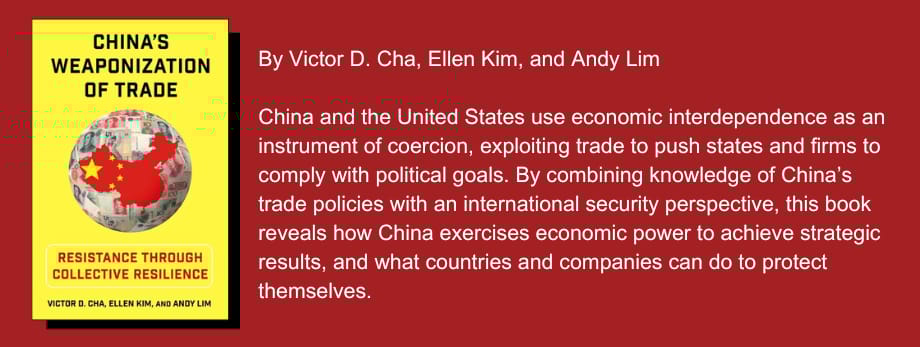
Book Recs
What we’re reading to better understand China
If you would like additional information and analysis tailored specifically for your specific business or institution, please contact us at [email protected].
Reply